
Know what to post,every morning.
In your inbox before work: what changed in your field overnight, up to three angles worth posting about it, and the source behind each one. A few minutes to read.
Not sure yet? Book a demo and Therese walks you through one.
For a company, an agency's profiles, or a person posting under their own name.
This is what one looks like
-
BSI updates PAS 9980: proportionate risk assessment or remediation delay?
constructionmanagement.co.uk ↗ -
Government pushes mortgage lenders to abandon EWS1 forms
insidehousing.co.uk ↗ -
CLC launches consultation on mandatory as-built and handover information
pbctoday.co.uk ↗
A real brief from 18 September 2026, for a company we invented.
A real brief
Every idea comes with the source behind it.
Real cards from the brief we ran on 18 September 2026 for a company we invented. Click any of them to read the whole morning.
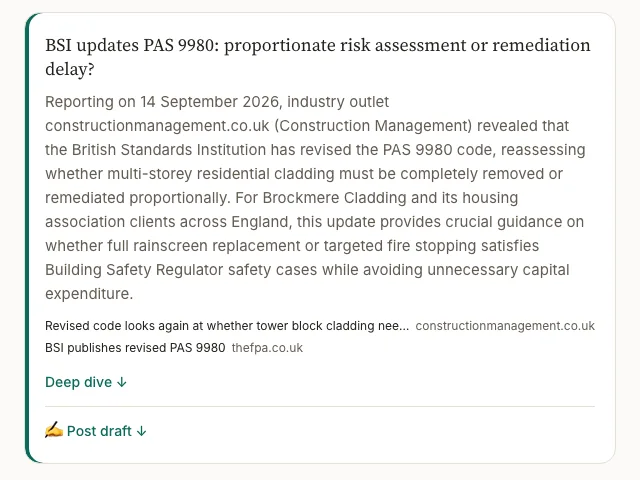
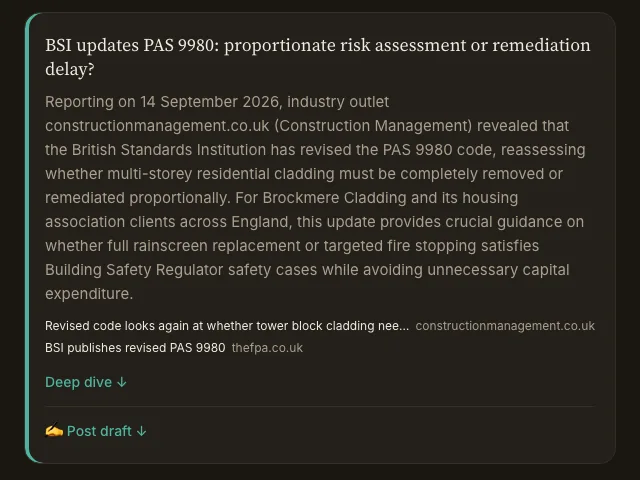
BSI updates PAS 9980: proportionate risk assessment or remediation delay?
Reporting on 14 September 2026, industry outlet constructionmanagement.co.uk (Construction Management) revealed that the British Standards Institution has revised the PAS 9980 code, reassessing whether multi-storey residential cladding must be completely removed or remediated proportionally. For Brockmere Cladding and its housing association clients across England, this update provides crucial guidance on whether full rainscreen replacement or targeted fire stopping satisfies Building Safety Regulator safety cases while avoiding unnecessary capital expenditure.
constructionmanagement.co.uk · 14 September 📈 Industry & economyCodi and Welsh Housing Partners Launch £750m Mixed-Tenure Framework
Inside Housing reported on 17 September 2026 that Wales' largest housing association, Codi Group, has partnered with Ateb, Hedyn, and United Welsh to launch a 750 million pound contractor framework running until March 2030 across six lots.
insidehousing.co.uk · 17 September Today's anglesGovernment pushes mortgage lenders to abandon EWS1 forms
Inside Housing reported on 16 September 2026 that a housing minister confirmed government efforts to stop lenders requiring EWS1 forms on residential blocks. For housing associations and developers, removing EWS1 reliance shifts the entire burden of proof directly onto the Building Safety Regulator safety case and golden thread records.
insidehousing.co.uk · 16 SeptemberThe publisher and the date are on the card and the article is one click away, so you can check the facts before you post.
In short
Therese AI works while you sleep.
The authorities, the trade press and the news in your field, read every night, and a short brief waiting for you in the morning.
Your morning
Your brief is ready when you wake up.
No number we cannot stand behind: the same half hour, spent differently.
Before
You opened five tabs and hoped something had happened.
Now
You read for a few minutes and see what changed.
Before
You wondered whether the thing you half remembered was still true.
Now
You click the source on the card and see it for yourself.
Before
You started from a blank page and a deadline.
Now
You edit a draft that already sounds like you.
The hunting is done by the time you sit down. What is left is the part you are good at.
What arrives
Read it over coffee, then decide what to post.
Eight parts, in the same order every morning, each in its own colour. A part you do not want is switched off in settings and never appears again.
Two or three sentences at the top: what today is about, so you know in ten seconds whether to read on.
Up to three ideas worth posting, ranked, each with the hook, why it matters now, and a draft you can edit.
What the authorities in your field published, read in full when it matters: what changed, who it affects, and why it may matter to you.
The trade press and the market signals behind it, with the number and the publisher on the card.
Requirements, reporting and the research the people who buy from you care about.
What is coming up in the calendar, and what other people in your field are doing well enough to borrow from.
What is catching on right now, picked for an honest bridge to your field rather than for the noise around it.
When there is nothing worth saying, the brief says so and gives the reason, instead of filling the page to look busy.
You never hunt for anything. You know where the regulation is, where the numbers are, and where the lighter ideas are.
How it is made
Set it up once. Get a new brief every day.
Ten minutes of your time, and only the first time.
-
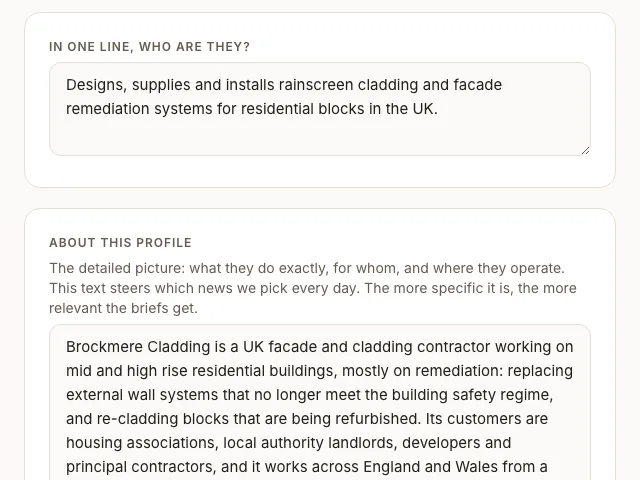
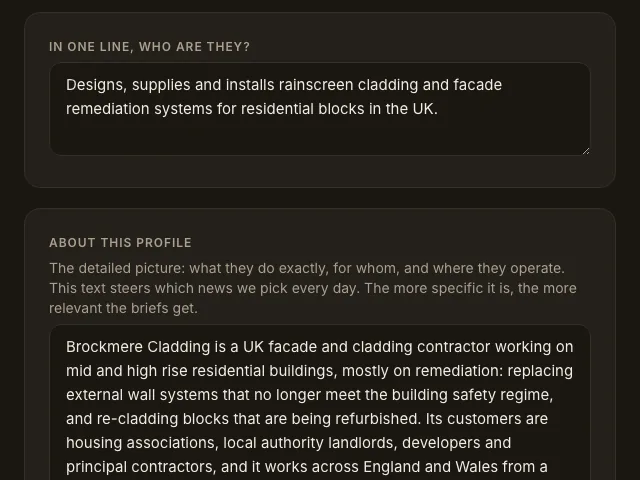 1
1We read your website and write the profile.
It decides which news counts as yours, so you read it once and correct anything that is not right.
-
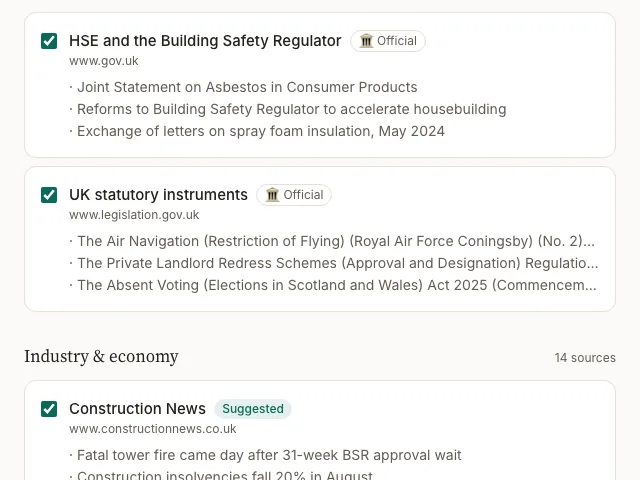
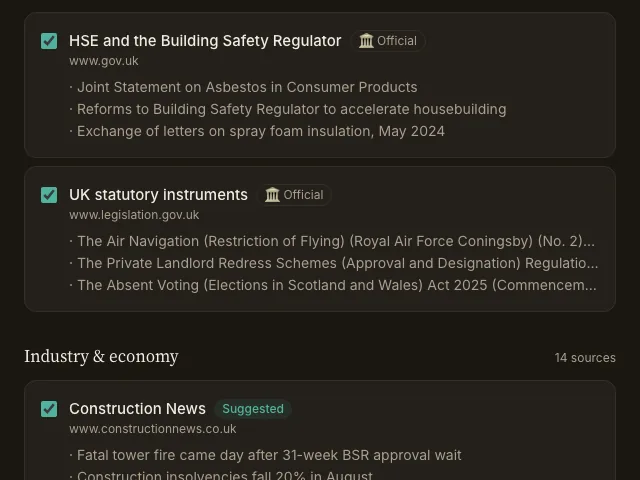 2
2You choose the sources you want to follow.
Authorities, the trade press, and the searches that catch the rest. Each one shows what it published today, so you can see what you are choosing.
-
 3
3The brief arrives before you start work.
Every card names its publisher, carries its date and links to the article, so you can check it before you post.
One rule we never bend. Regulation comes only from an authority's own register or feed, on its own domain, checked against a public record. Never from a blog that read it.
After those ten minutes it runs by itself. Nobody has to remember to start it.
Compared to a chat assistant
It follows your business, not just your question.
Therese AI learns the company or the person behind the profile, watches the sources that belong to them, and turns what is new into something they can post about.
A chat assistant
Therese AI
You have to know what to ask about
You go looking for the subject yourself.
It watches what matters to your profile
It follows the authorities, the trade press and the trends that belong to your business.
It gives you an answer
You work out yourself whether it is relevant.
It gives you something worth posting about
It ties what happened to your business and hands you the source, the summary and an angle.
You steer every task
The next answer depends on your next instruction.
It learns what you actually use
What you use, skip and publish shapes tomorrow's brief and the way the drafts are written.
One question at a time
You open the chat when you need something.
It keeps running, for every profile
Briefs are written every night, kept, and worked on together with your team.
What a chat assistant is better at: a quick rewrite, a brainstorm on demand, a translation, a format you have never used. We use one too.
Set the profile up once. Therese AI keeps following, filtering and learning, every day.
Who wakes up to it
Four people, four very different mornings.
The same brief, read for four different reasons.
An agency
One brief per profile, open before the first meeting. The writer on that account walks in knowing what is worth posting today.
An in house team
Someone takes a card so nobody writes it twice, asks a colleague to check the source, and the post is out before lunch.
A company with no marketing team
Up to three ideas and a draft for each. Pick one, check the source, make it yours, post it. That is the whole marketing routine.
An executive
What moved in the field overnight, read first thing in the morning, with an angle worth writing under their own name.
Whoever you are, the part that used to take the morning is done before you sit down.
Built to be checked
You can check every card, and it never touches your accounts.
The five things a careful buyer asks about first, answered before you ask.
-
✓Every card links to its source.
The publisher and the date are on the card. Nothing asks you to take our word for it.
-
✓A thin day is labelled a thin day.
With the reason, instead of filling the page to look busy.
-
✓It never touches your channels.
No passwords, no posting on your behalf, no access to anything you own. You copy what you want and publish it yourself.
-
✓Your material is not used to train models.
Your profile, your posts and your feedback make your own briefs, and are otherwise used only anonymised and aggregated.
-
✓Regulation comes from the authority itself.
An authority's own register or feed, on its own domain, checked against a public record. Never a blog that read it.

I did this by hand for my own clients every morning for years: read the authorities, read the trade press, and work out what was worth saying. It is the part nobody has time for, so we built the thing that does it.
We would rather hand you a shorter brief you can check than a full one you cannot.
Questions
Six questions you probably want answered first.
Short answers. The longer list is on the questions page.
- Does it post for me?
- No, and it never has access to your accounts. It hands you the idea and a draft; you publish it yourself.
- Will it sound like me?
- Paste a post as it went out and the next drafts follow your length, your openings and your words.
- What happens on a quiet day?
- It says so, and why. You get a shorter honest brief rather than a padded one.
- What if a card is wrong?
- Every card links to the article it was built on, so you check it before you post. We never claim a card cannot be wrong.
- Which languages and markets?
- It reads across languages and writes in yours, for the markets you name. It is not a Swedish only product.
- How long does setup take?
- About ten minutes, once: your website, the profile we drafted from it, and the sources you want.
Where to start
Read one, then decide.
The brief above is the whole thing, with nothing taken out. If you would rather see it on your own field, leave your email and Therese will walk you through one.
Not sure yet? Book a demo and Therese walks you through one.